


Ras Al Khaimah
- Dec 25, 2017
- 2 min read

With over 7,000 years of fascinating history and culture, Ras Al Khaimah is the perfect getaway from everyday life. Offering magnificent landscapes, breathtaking coastlines and rich, terracotta desert planes, the emirate has firmly established itself as the UAE’s most authentic destination in the Middle East.
With year-long sunshine and 64 kilometres of white sandy beaches, just 45 minutes from the busy metropolis of Dubai, Ras Al Khaimah offers an entirely unique experience from its neighbouring emirates.
Ras al-Khaimah (alternatively Ra'sal-Khaymah or Ras el-Kheima; Arabic: رأس الخيمة; IPA: [raʔs alˈxajma]) is one of the seven emirates that make up the United Arab Emirates (UAE). The current statehood is the result of the 1909 appanage from Sharjah. Its name could be taken to mean "headland of the small huts", which can be attributed to the indigenous buildings that existed along the coast. The emirate is in the northern part of the UAE, bordering Oman's exclave of Musandam. It covers an area of 1,684 km2 (650 sq mi). The capital city and home of most residents is also called Ras Al Khaimah. The emirate had a population of 210,063 at the 2005 Census, of which 41.82 percent or 87,848 were Emirati citizens. Latest estimates put the total population at between 250,000 and 300,000. Locals accounted for 97,529 in the population estimate for 2010.
The city has two main sections, Old Ras Al Khaimah and Nakheel, on either side of a creek. It is served by the Ras Al Khaimah International Airport. It consists of a northern part (where the city of Ras al-Khaimah is situated), and a large inland exclave in the south (near Hatta), and a few small islands in the Persian Gulf.[2] Ras al-Khaimah has the most fertile soil in the country, due to a larger share in rainfall and underground water streams from Omani mountains.
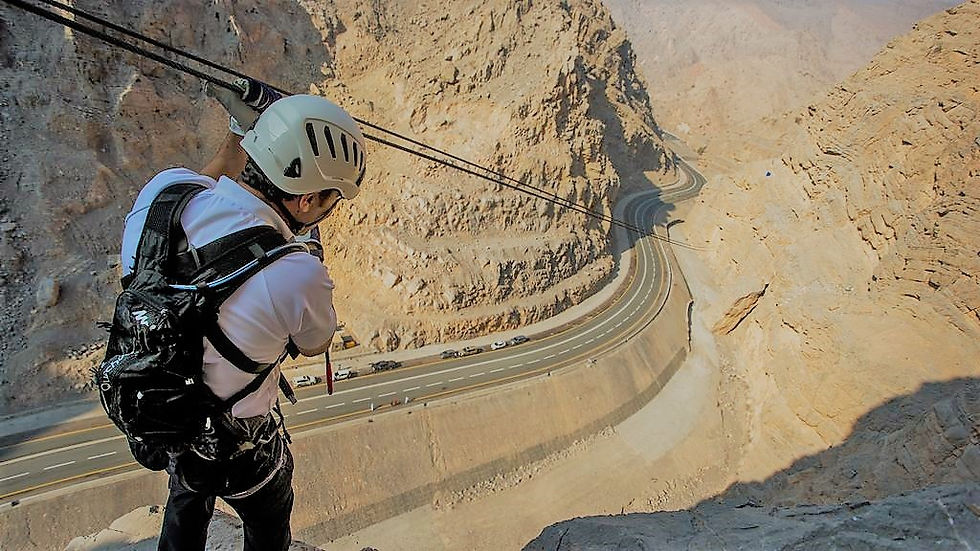
Surrounded by the fierce Hajar Mountains, Ras Al Khaimah (or simply ‘RAK’) is the UAE’s northernmost emirate. Outdoor enthusiasts love it here, thanks to diverse scenery ranging from sandy beaches to sprawling oases, hot springs to sun-baked desert, all backed by the rugged mountains.
Growth has been exponential in RAK in recent years, resulting in a free-trade zone, an artificial island with luxury resorts, new leisure facilities and a mountain road offering glorious views. Most of the development is based in an area called Al Hamra, some 15km south of RAK City.
In RAK City itself, the pearly-white and multidomed Sheikh Zayed Mosque overlooks the Al Qawasim Corniche, a paved promenade with kiosks, benches and restaurants fronting the creek.
RAK is also the gateway to the magnificent Musandam Peninsula, an enclave of Oman.


Comments